Picture a brilliant engineer, dropped blindfolded into the control room of a manufacturing plant that has been running for thirty years. He knows the theoretical physics cold. He could recite every modern optimization formula without hesitation. What he does not know is that the third conveyor belt needs a manual recalibration every Tuesday, or that someone rewired the temperature gauge on the primary furnace a decade ago to work around a sensor that never got fixed.
Act on theory alone, and he brings the plant down.

That is essentially what is happening across enterprise software right now. Seduced by what generative AI can do in clean, controlled environments, organizations are pointing it straight at their legacy IT estates and expecting technical debt to simply dissolve.
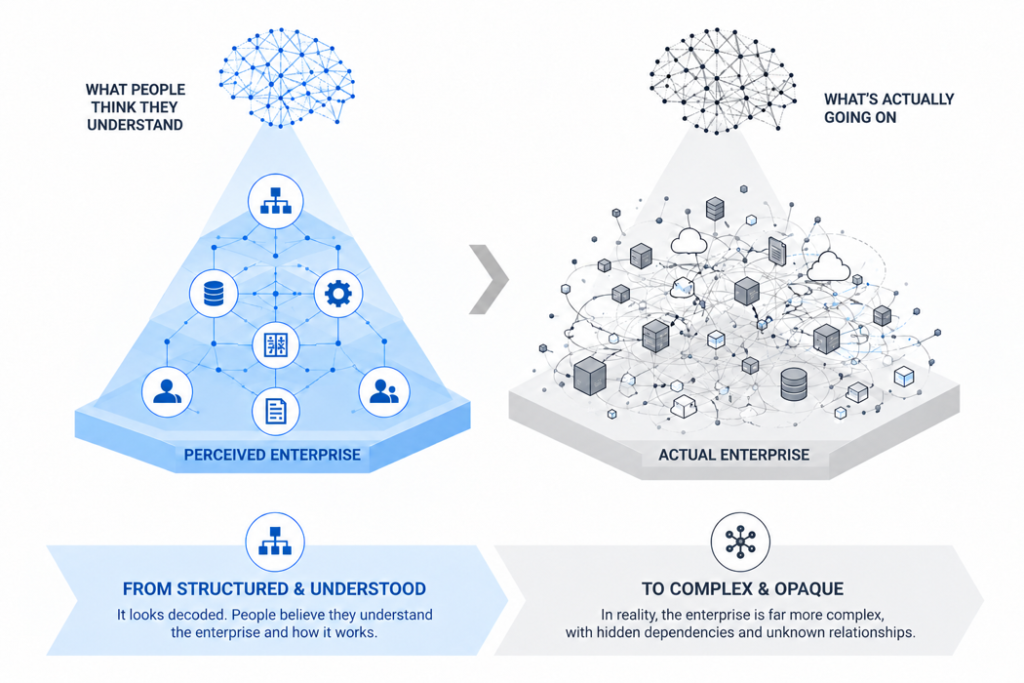
When we say “generic AI” here, we mean a capable foundation model applied directly to a codebase with no picture of the specific enterprise it has landed in. A brownfield estate is a layered environment of legacy code, bespoke business rules, and undocumented workarounds built up over years. Point that same model at one, and it does not get any less capable. It simply runs out of the information it needs. Asked to refactor a module with no history behind it, it produces something plausible and complete-looking, because that is what a competent model does with an incomplete brief. The danger was never bad syntax or model inadequacies. It is the dependency nobody wrote down, or the block of code that looked redundant but was quietly carrying business logic no one remembered.
None of this is an argument against generic AI. It is an argument for giving it what it actually needs to do brownfield work safely: the same grounding a seasoned engineer would insist on before touching a system this complicated. That is what we mean by Contextual AI: not a different model, but a different starting point, where AI is used first to understand the enterprise, and only afterward to change it. We call the underlying idea “AI for AI”: one layer of AI discovering and structuring the context that a second layer, the one actually writing code or automating work, depends on.
Two kinds of Context that Code alone will Never Show You
Generic models are trained on an enormous slice of public code and documentation, so they are genuinely strong on standard architecture, modern syntax, and textbook engineering. What they have never seen, because it exists nowhere on the public internet, is your enterprise, and specifically two layers of context that determine how a brownfield system really behaves.
| Technical Context | Functional Context |
|---|---|
| The first is technical: how a modern microservice talks to a legacy mainframe, how data actually flows through custom middleware, which dependencies were never documented because whoever built them assumed they would always be around to explain it in person. | The second is functional: the business reality sitting inside the code, meaning the domain rules, regulatory checks, and value streams the software was built to enforce, often with no record anywhere except the code itself. |
Without visibility into both, an AI coding assistant treats a legacy module as a block of text waiting to be improved, not as a living part of a system with a history and dependents. That is where “modern legacy” comes from: code rewritten into a clean, current language while the business logic underneath, outdated parts and all, gets carried across unexamined. It looks like progress on the surface. Functionally, the enterprise has just repainted the same risk in a newer color.
A Rule nobody could see in the Code
Here is why reading code is rarely enough on its own.
During a modernization effort for a large logistics operator, an AI-powered system scan identified a putaway routine in the warehouse management system that appeared redundant: a near-duplicate of the standard process, applied to a narrow slice of SKUs, with no comment explaining why it existed. The underlying condition that had originally justified the routine no longer existed, and the business documentation made no reference to it. Yet the routine was still embedded in the code and continued to shape warehouse operations simply because no one had ever removed it.
The change had been made years earlier in response to a specific operational requirement. Over time, the relevant customer relationship had ended, the original packaging and SKU classification had changed, and the condition that had prompted the exception had disappeared. But the code was never revisited, and the variation in practice continued.
The scan surfaced something more valuable: the condition no longer existed, yet the practice created to address it was still embedded in the system and the operating process.
That discovery prompted the team to ask a different question: not “How do we preserve or consolidate this code?” but “Why are we still doing this at all?” The answer was that the routine was no longer needed, either in the code or in practice, so the team retired both the legacy logic and the operational step.
That is precisely the category of hidden legacy that automated discovery uncovers when it traverses the landscape and connects the dots: not just code that nobody understands, but practices where the reason for a change has disappeared, while the change itself continues to live on.

Context is the Scarce Resource
For the past few years, the enterprise AI conversation has organized itself around the wrong scarcity. Everyone raced to secure compute, license the sharpest model, ship the cleanest interface. Model capability is increasingly accessible across vendors, and compute can be procured. What cannot be bought off a price list is verified, current, structured knowledge of how a specific enterprise actually works. That asset is unique to each organization, and more often than not, it does not already exist in usable form even inside the company. It has to be discovered and kept current, because brownfield systems never sit still long enough for a one-time documentation push to stay accurate.
The organizations getting real value from AI in these environments tend not to be the ones with the best model access. They are the ones treating context construction as a genuine engineering discipline in its own right, deserving the same investment and governance as the AI capability sitting on top of it.
Spend the AI budget on copilots and interfaces before investing in that foundation and you are optimizing the wrong end of the value chain.

Turning AI on the Discovery Problem Itself
If context is the bottleneck, and it is scattered across code, documentation, runtime behavior, data lineage, and people’s memory, then finding it is itself a hard reasoning problem: pattern recognition and synthesis across many sources at once. For a problem like this, we need purpose-built AI capabilities, not existing tools repurposed for the job.
That is the thinking behind “AI for AI”: using AI not as the end-facing tool, but as the layer that reconstructs the context that later AI work will depend on. Rather than one model filling gaps with its best guess, a dedicated layer of AI agents gets set loose on the estate with a single mandate: establish what the system actually is and does, not what it was once documented to be, and represent that in a form other AI systems and people can reliably use. It inverts the usual order. Instead of asking what a model can do for people, it asks what specialized agents can do to reconstruct the ground truth of the systems first, so that whatever gets built afterward starts from something accurate.
Three things set this apart from most current AI deployments. It runs continuously, since documentation always goes stale, and an agent-based capability can revisit the estate on a schedule instead of waiting for the next expensive audit. It draws on multiple sources at once (code, tickets, telemetry, data lineage, and the operational systems where a practice actually shows up) rather than trusting any single one, the way the warehouse example required checking code against what was actually happening on the operations floor. And it produces structure, not narrative: a model of the enterprise capturing how things relate and where the risk actually sits, not another wiki page destined to rot.
The Cognitive Spine
That structured output is what we call the Cognitive Spine: a continuously maintained map of an enterprise’s functional and technical topology, built and kept current by a coordinated group of specialized AI agents.
The name is meant literally. A spine holds a structure and carries signals to the rest of the body. A Cognitive Spine does the same job for a digital estate: it holds the structural truth of how systems and business functions relate, and every later AI initiative, whether modernization, risk analysis, or automation, draws its context from that layer.

Three properties define a Cognitive Spine and separate it from the static architecture diagrams and data catalogs most enterprises have already tried.
| It is discovered, not declared. | Rather than asking teams to self-report their systems’ architecture, an exercise that is inevitably incomplete, political, and outdated the moment it is finished, the spine is built by agents that actively read code, trace data flows, parse integration contracts, and mine incident histories. The resulting model reflects what the system does, not what someone once intended it to do. |
| It is functional as well as technical. | It covers business logic, not just technical structure: mapping which capabilities depend on which components, and where regulatory obligations are actually enforced versus quietly assumed. That is what makes it useful to a CXO, not only to an architect. |
| It is a substrate, not a deliverable. | The spine is not a report read once and archived. It is meant to be queried, extended, and reasoned over continuously: by engineers doing modernization work, by risk teams doing impact analysis, by AI agents executing change safely because they finally have a reliable map of where they are operating. Every AI capability the enterprise deploys afterward, whether a coding copilot, a compliance assistant, or an autonomous remediation agent, becomes measurably more trustworthy the moment it is grounded in the spine, because it is reasoning from verified structure instead of improvising over a black box. |
What makes this Work in Practice
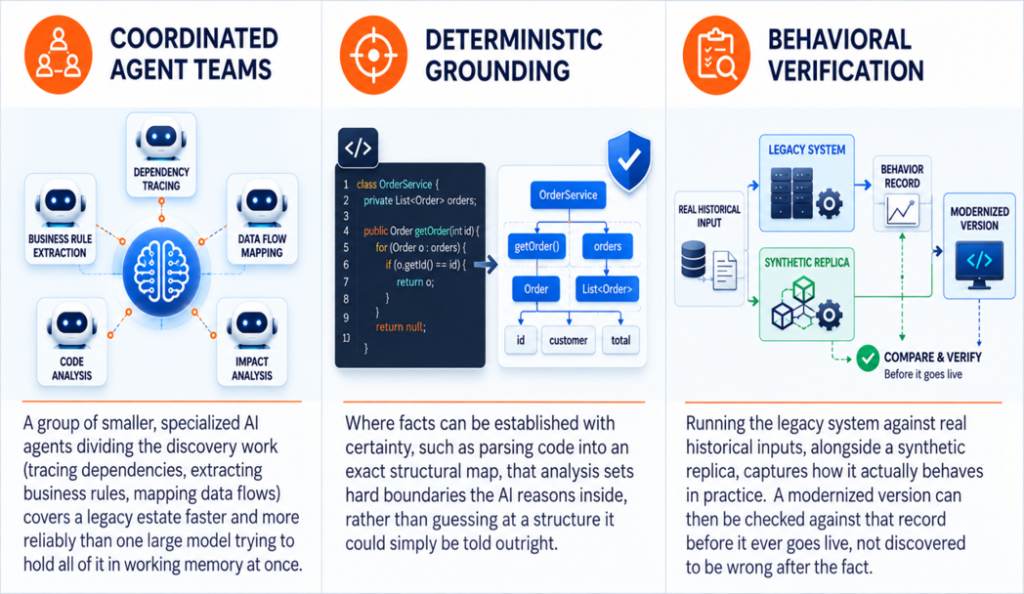
Building a Cognitive Spine well comes down to a few practical techniques. Each earns its place on merit, not on how impressive it sounds.
The CXO Playbook
Four shifts matter for how leadership approaches this.
| Fund discovery as an asset, not a preliminary step: | Treat building a Cognitive Spine as creating something the enterprise keeps and reuses for years, not overhead to clear before the “real” project starts. |
| Ask for seams, not big-bang rewrites: | AI makes it tempting to move fast, and a wholesale rewrite done fast is riskier, not safer. Push your teams to find the seams first, the points where one specific legacy function can be pulled out and modernized on its own, without dragging everything around it into the same change. |
| Measure comprehension, not just code output: | Lines of code shipped says almost nothing about whether the work was done safely. What actually predicts a smooth rollout is how much business logic your team has surfaced and verified, and how much of the modernized code has been checked against how the old system actually behaved. |
| Keep deterministic facts and AI reasoning connected but distinct: | Use structural analysis tools to establish what is actually true about the system and let AI agents translate and accelerate the work inside those facts, not instead of them. |

The Bottom Line
The mistake most enterprises are making is not choosing AI. It is skipping the step of teaching it what it is actually working with. Decades of business decisions live nowhere but in code, in enterprise memory, and in what a system actually does under real conditions, not in what anyone wrote down about it.
Treating that as a problem a good enough prompt can solve is exactly what stalls these transformations.
Give AI the same grounding a good engineer would insist on before touching anything. Generic AI is a genuinely powerful tool. What decides whether it is safe to use on a brownfield estate was never the model: it is whether the enterprise made itself legible to that model first.
eSL Veda brings Contextual AI to the realities of complex enterprise systems, turning hidden complexity into intelligence leaders can act on with confidence. When your next transformation reaches the boardroom, see what changes when AI truly understands the enterprise.